Nobody Ships a Site Like This Alone
The new Cyberdogz website and why a site built by an agency team beats one built by a single freelancer, plus the move from WordPress and a page builder to headless WordPress, Astro and an AI-assisted pipeline.
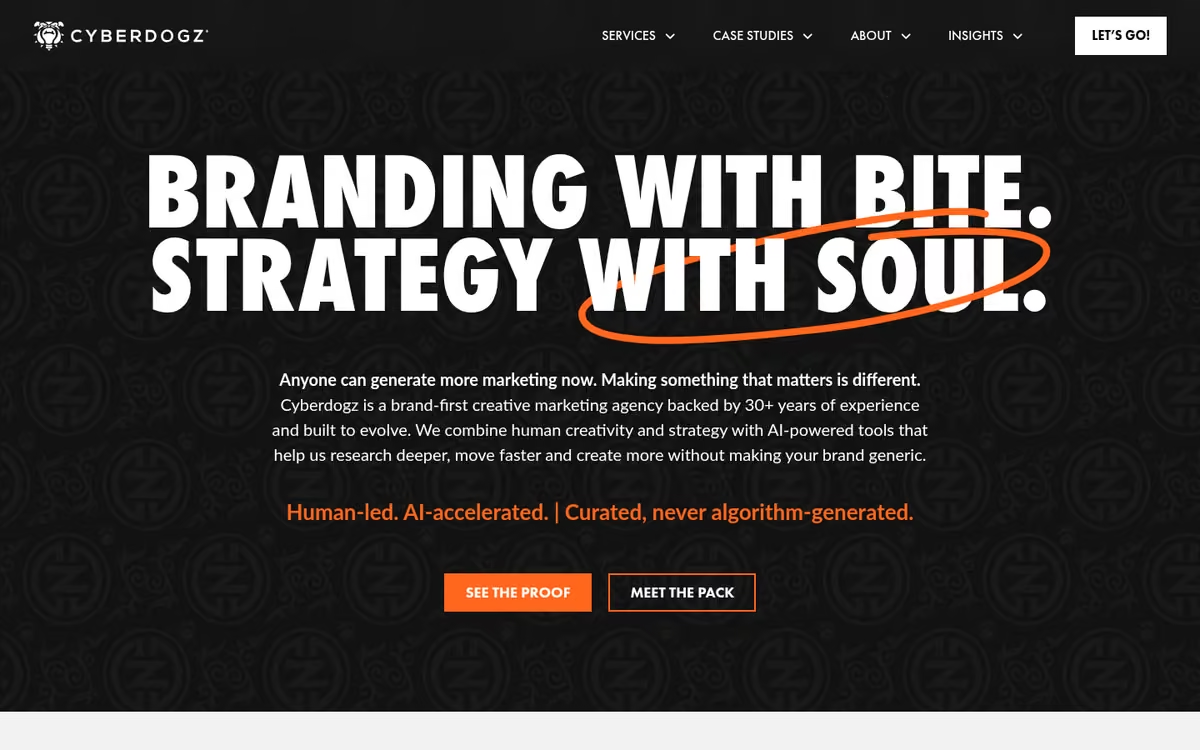
Cyberdogz has a new website.
I am the lead web developer on it.
That sentence is accurate, and it is also the least interesting thing I can tell you about the launch.
The freelancer pitch is not wrong. It is incomplete.
You have heard the pitch, and you may have made it yourself. Why pay an agency when one good developer can build the whole thing?
One good developer can build a fast, clean, well-structured site. I know, because that is my job.
What one person cannot do is be five people at once. Not because of talent. Because of attention, and because of independence.
A freelancer designs the page, builds the page, writes the copy for the page, decides what the page is for, and then reviews the page. Every one of those steps passes through the same head, with the same assumptions and the same blind spots. When the person who built it is also the person who approves it, the review is not a second control. It is the first control, repeated.
I have written about why two checks that fail for the same reason are really one check. A website is no different. The value of a team is not that there are more hands. It is that the hands belong to people who see different things.
The brand had to survive the rebuild
Branding with Bite. Strategy with Soul.
That line is not decoration. It is the brand, and a rebuild is exactly the moment a brand gets diluted: a font that almost matches, a color that drifted, a layout that is technically cleaner and somehow says less.
The design team owned that. My job was to translate their work, not reinterpret it. When a developer starts "improving" a design because the code would be simpler, the brand loses, quietly, one component at a time.
A good working relationship between design and development is not the developer saying yes to everything. It is both sides knowing which decisions belong to whom.
The role nobody screenshots
Project management never appears in the launch post. There is no screenshot of it.
But somebody kept scope from growing every week. Somebody decided what ships now and what ships next. Somebody made sure design, development, content, QA and marketing were working on the same version of the project instead of five slightly different ones.
On a solo project, that job does not disappear. It just gets done by the developer, at night, badly, between commits.
Somebody whose job is to assume I am wrong
I build things. A QA team exists to assume I built them wrong.
That is not an insult. It is the most useful service anyone can provide to a developer. I have spent a whole series arguing that error should be the starting assumption, and that the right target is the work, not the people. This project was the version of that argument with a launch date attached.
The defects QA catches before launch are not failures. A defect found internally is a win, not an embarrassment. The embarrassing version is the one the client's customer finds.
A site that has to earn its keep
A beautiful site that does not produce leads is a brochure with hosting costs.
Marketing direction designed the lead strategy before anyone touched a component. Who is this site talking to, what are they looking for when they land, and what is the next step we want them to take on every page.
You can see it in the result. See the proof. Meet the pack. Let's talk. Every section knows what it wants the visitor to do next.
That is not something a developer bolts on at the end. It is a decision about the whole site, and it shapes the structure, the copy and the components. When it comes first, development gets easier. When it comes last, it becomes a pop-up.
The part that changed under the hood
The previous site was built the way a lot of agency sites still are: WordPress, a page builder, and a lot of manual work.
That combination has a cost that never shows up in the quote. Every page is assembled by hand. Every change goes through the builder's way of doing things. Performance is whatever the builder allows, and security is whatever the plugin stack happens to be this month.
The new site splits the job in two.
WordPress stays where it is good: a place where people who are not developers write and manage content.
Astro does what WordPress was never good at: the public site. Static pages, built ahead of time, served from the edge. There is no WordPress on the public site at all, which means no PHP, no plugins and no admin panel sitting in front of every visitor.
And between the two, a pipeline. With AI in it.
AI goes where the heavy lifting is
The agency's own homepage says it better than I can: Human-led. AI-accelerated. Curated, never algorithm-generated.
This launch is the agency building its own site the same way it sells its work.
AI earned its place in the pipeline doing the heavy lifting: the repetitive, high-volume, well-specified work that used to eat a project's hours. Structure, scaffolding, migration, the kind of transformation that is tedious for a person and trivial to verify.
What AI did not do is decide. It did not decide what the brand sounds like, what the site is for, which lead matters, or whether a page was ready to ship. Those stayed with the people whose job it is.
That split is the whole point. I made the argument in Yes, I Have 100: writing code stopped being the expensive part. What is left, and what got more valuable, is everything around it. Strategy, brand, experience, and the judgment to know when something is right.
An agency that hands AI the judgment is selling generic. An agency that refuses AI the lifting is selling hours it no longer has to spend. The interesting work is drawing the line in the right place.
Fast and secure are team outcomes too
Performance and security sound like developer metrics. They are not, entirely.
A site is fast because design did not ask for a carousel nobody would watch, because marketing chose what each page has to do instead of what it could hold, and because the architecture keeps the heavy machinery away from the visitor.
A site is secure because the public surface is small. Static pages have very little to attack. The CMS still exists and still needs care, but it is no longer the thing every visitor touches. Security, as I keep saying, is layers, and the biggest layer you can add is not having the risk in front of the public at all.
None of that is one person's achievement. It is what happens when every role does its part with the others in mind.
So, who built it?
Design built the brand into it. Project management kept it on one track. QA made sure it works the way it claims to. Marketing made sure it is worth visiting. AI carried the weight it is good at carrying.
And I wrote the code that holds it together.
That is the honest credit for a site like this. Nobody ships one alone.
If you need an agency result, hire an agency
A freelancer is a great answer to a developer-sized problem. A fix, a feature, a fast site for a business that knows exactly what it needs.
But if what you need is a brand that holds up, a strategy that brings in leads, and a site that is secure and fast because a whole team made it that way, that is not a developer-sized problem. Hiring one person to solve it does not make it smaller. It just puts all of it on one desk.
If you need an agency result, hire an agency. Talk to Cyberdogz.